The LGBT community and its struggles for equality will share the stage alongside other communities advocating for social justice as community organizers, activists and civil rights leaders participate in a host of activities to commemorate the 50th anniversary of the 1963 March on Washington for Jobs and Freedom.
The march, famous for Martin Luther King Jr.'s ''I Have a Dream'' speech and for raising the country's consciousness, focused on the struggle for equal rights, particularly on economic opportunity. This 50-year commemoration of that Aug. 28, 1963, mark on America's timeline will also celebrate the ongoing work of activists and advocates working for voting rights, immigration reform, employment and LGBT equality.

March on Washington
(Photo by Library of Congress, Warren K. Leffler: U.S. News World Report Magazine Collection)
On an Aug. 20 conference call, Chad Griffin, president of the Human Rights Campaign, the nation's largest LGBT civil rights organization, said the aim of the march, as it was 50 years ago, is to urge Congress to take legislative action on these various fronts. With regard to LGBT rights, Griffin focused on the struggle for marriage equality and the pending Employment Non-Discrimination Act (ENDA), which would provide federal workplace protections for LGBT people.
Many of the LGBT-related local events between Aug. 23 and Aug. 28 will invoke the name of the late Bayard Rustin, the gay civil rights leader who worked closely with King on several initiatives and is credited with planning the 1963 March on Washington. On Aug. 8, the White House announced that President Barack Obama will posthumously award Rustin with the Presidential Medal of Freedom.
Among those LGBT-related events, the Mayor's Office of GLBT Affairs, in partnership with the Mayor's Office of Community Affairs, the National Gay and Lesbian Task Force, the Human Rights Campaign, the National Black Justice Coalition and the Center for Black Equity, will host a forum, ''What's the Unfinished Business for the LGBT Community?'' to discuss the progress made since the original March on Washington and future challenges confronting the movement.
Sterling Washington, director of the Mayor's Office of GLBT Affairs, says that event will feature various speakers representing different movements within the LGBT community. The event will be held Friday, Aug. 23, from 4:30 to 6:30 p.m., in the foyer of the Rayburn House Office Building, at 45 Independence Ave. SW.
On Saturday, Aug. 24, organizers will hold the first of two major marches, with the second occurring on Aug. 28, the exact anniversary. Prior to the Aug. 24 ''Action to Realize the Dream March and Rally for Jobs, Justice & Freedom,'' sponsored by the National Action Network, Mayor Vincent Gray and other advocates for D.C. statehood, including the organization DC Vote, will host a short rally at 8:30 a.m. at the District of Columbia War Memorial, on the north side of Independence Avenue SW, across from the Martin Luther King Jr. Memorial.
The statehood rally will include a contingent from the city's major Democratic LGBT organization, the Gertrude Stein Democratic Club of Washington. Participants will then feed into the larger march, starting at 10 a.m.
On Monday, Aug. 26, the A. Philip Randolph Institute, an AFL-CIO-affiliated organization, along with the National Black Justice Coalition and the American Federation of Teachers, will host ''A Tribute to Bayard Rustin and the 50th Anniversary of the 1963 March on Washington,'' which will focus heavily on Rustin's role in organizing and executing the famous march.
That event will be held from 6 to 9 p.m. at the Historic Lincoln Theatre, located at 1215 U St. NW, and will include a screening of a segment from the award-winning documentary Brother Outsider: The Life of Bayard Rustin.
Wednesday, Aug. 28, the Center for Black Equity will host an event commemorating the role that Rustin played in organizing the march, with a panel discussion featuring Congresswoman Eleanor Holmes Norton (D-D.C.); Mandy Carter of the National Black Justice Coalition; Damien Connors, the national executive director and chief operating officer for the Southern Christian Leadership Conference Inc. (SCLC); and the Rev. MacArthur H. Flournoy, who serves as the director for faith partnership and mobilization at the Human Rights Campaign (HRC). The discussion, followed by a reception, will be held at the HRC Equality Forum at 1640 Rhode Island Ave. NW, at 7 p.m., and will be broadcast live enabling viewers to ask questions and engage in online chat during the event.
Another event, sponsored by the DC Commission on the Arts and Humanities, celebrating Rustin and the gay African-American novelist James Baldwin, was originally scheduled for Aug. 22, but has since been postponed to September.
For more information about LGBT-related events during the March on Washington 50th Anniversary, call the Mayor's Office of GLBT Affairs at 202-727-9493 or visit glbt.dc.gov. For general information on commemoration events, visit marchondc50.dc.gov.
...moreWhen it comes to dates, Paul Kuntzler is a sort of human computer.
''I first came to Washington on Wednesday, Jan. 18, 1961, for John Kennedy's inauguration,'' Kuntzler recalls, citing the historic event that occurred two days later. He easily recalls the dates – and days of the week – of, for example, meeting gay-rights pioneer Frank Kameny, who invited him to join the Mattachine Society, harbinger of the country's modern LGBT-rights movement.
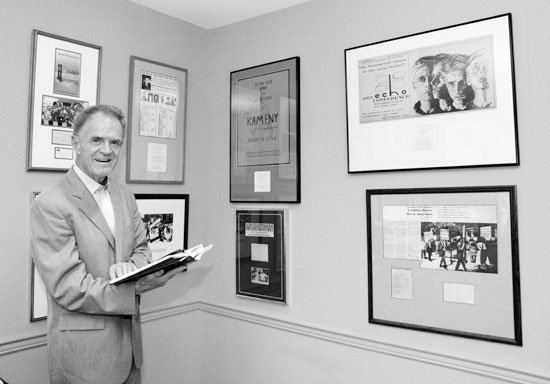
Paul Kuntzler
(Photo by Patsy Lynch)
''I participated in the first gay-rights picket in front of the White House on Saturday, April 17, 1965,'' he says of his Mattachine roots. ''There were 10 of us – seven men and three women.''
He moved in with his partner, Steven Brent Miller, May 29, 1962, enjoying a life together until Miller's death in 2004.
The Detroit-area native, active in Democratic politics since his youth, remembers much – like helping to found the Gay and Lesbian Activists Alliance of Washington, D.C., and the Gertrude Stein Democratic Club. Certainly, he remembers Wednesday, Aug. 28, 1963.
METRO WEEKLY: By the time of the march, you were serving on the board of the Mattachine Society of Washington?
PAUL KUNTZLER: I was elected to the board of directors of the Mattachine Society April 3, 1962. I was just 20 then, the only minor involved in this tiny gay-rights movement, which consisted of no more than 150 people in five American cities: Washington, Philadelphia, New York, San Francisco and Los Angeles.
MW: Was it more dangerous at the time to be single or to be a couple?
KUNTZLER: Well, it was difficult whether you were single or a couple, because there was a total ban on lesbians and gays working in the federal government, including the District government. The American Psychiatric Association classified us as mentally ill.
MW: What can you tell me about the day of the march?
KUNTZLER: First of all, President Kennedy declared a virtual state of martial law. There was this belief that there were going to be riots. A lot of offices were closed, including my own.
MW: Were you expecting any rioting?
KUNTZLER: Not really. But the idea of a huge march on Washington was a radical idea in 1963. It had never happened before. I didn't really expect any problems, but I knew there was this belief that there might be riots. Of course, there weren't. There was virtually no crime that day.
MW: It actually looks like it was a beautiful day.
KUNTZLER: It was – sunny, in the 80s.
MW: How did that Wednesday unfold for you, a young, gay, white man joining this March on Washington?
KUNTZLER: In the morning, probably about 11 o'clock, I took the bus to the Washington Monument grounds where the crowds were gathering. There were civil rights organizations, church groups and trade unions. I remember being on the monument grounds and a woman saying, ''The buses are still coming through the Baltimore Harbor Tunnel.'' There were about 2,000 buses.
My father had been a member of United Auto Workers. Walter Reuther, president of the UAW in Detroit, he was one of the march leaders. He spoke that day. So I decided to march with the UAW down Constitution Avenue to the Lincoln Memorial.
MW: And then the music and speeches began?
KUNTZLER: Peter, Paul and Mary sang, ''If I Had a Hammer'' and ''Blowing in the Wind.'' There was a gospel singer and others. There were a number of actors – Paul Newman, Marlon Brando, Charlton Heston, Sidney Poitier, Diahann Carroll, Harry Belafonte….
MW: Where were you?
KUNTZLER: I was on the side of the Reflecting Pool underneath the trees, near the temporary World War II buildings. I could see soldiers lined up against the temporary buildings. There was a tremendous amount of military force.
MW: Could you hear everything well?
KUNTZLER: Yes, very much so. The speaker system was very clear. I could hear all the speeches.
MW: Is there a particular memory of the day that stands out for you?
KUNTZLER: I have a very strong emotional memory of people joining hands together, swaying and singing, ''We Shall Overcome.'' That was sung throughout the day. It was very emotional.
MW: What was your motivation for joining the march that day?
KUNTZLER: There was a lot of racism and segregation in Washington.
As difficult as it is now to believe, Steven was on the staff of the House Appropriations Committee – 22 white males. They only hired white males. He was going to the Stenotype Institute of Washington to become a stenotype reporter. Only whites were permitted to attend the institute, as was the case with all of Washington's business schools.
In early 1962, I saw an ad in The Washington Post about a job. I had to go over to an Arlington employment agency. I got a job in the proofing department of Union Trust Co. This employment agency over in Arlington had an agreement with Union Trust that they would only send white applicants. For the several months I worked at Union Trust, there was a young woman I worked with, someone I befriended. She had an African-American boyfriend and all my colleagues were openly critical.
People would say things, express racial attitudes quite openly. That always offended me.
MW: Did your feelings about racial equality come from your family?
KUNTZLER: I think it had to do with the fact that I was gay. I thought [the march] helped push a progressive agenda – not just for African-Americans, but for anyone who was oppressed. I always thought these issues were linked together. That's why I was always opposed to racism.
It was like a straitjacket when I came here. There was a lot of racism in the Detroit area, but people didn't express it like they did in the early '60s here in Washington. It was a very Southern city then.
MW: Did the march inspire Mattachine members?
KUNTZLER: It inspired all of us, because people came from around the country and they went home to their communities with an inspired message that helped bring about change.
All three television networks covered it live. I got home and they were replaying it. People saw it all over the country. It had a profound effect on people's attitudes all over the country. They thought there were going to be riots, but here was a very solemn, peaceful, enormous congregation of people. MW: How far have we come since that day?
KUNTZLER: It's extraordinary. We couldn't even conceive back in the '60s that we'd make the progress we've made. The struggle for human rights never ends. It's something you're always having to work at. We've made extraordinary progress, but in terms of all groups it's an ongoing process. I was very proud of having participated.
...moreAt 35, Aisha Moodie-Mills was a long way from arriving on the scene when the March on Washington for Jobs and Freedom took place. But she carries on the legacy of activism today, fully present in her position as a senior consultant at the Center for American Progress, founded in 2003 by Bill Clinton's White House Chief of Staff John Podesta. At CAP, Moodie-Mills heads up the FIRE (Fighting Injustice to Reach Equality) Initiative, ''at the intersections of race, sexual orientation, and gender, as well as environmental and economic justice.''
That is, however, hardly the end of this dynamo's résumé. You might catch her and her wife, Danielle Moodie-Mills, on their fun and informed weekly Politini podcast. Speaking of her wife, this couple's D.C. marriage was made possible, in part, by work they did securing marriage equality for the District. And maybe you caught the couple's Aug. 16 piece for The Washington Post? Or Aisha Moodie-Mills's column in The Atlantic assessing the Supreme Court's rulings on marriage equality and voting rights?
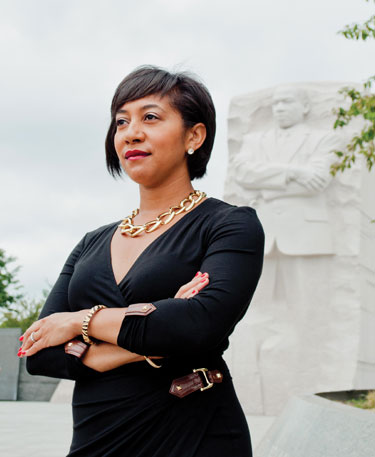
Aisha Moodie-Mills
(Photo by Todd Franson)
From Capitol Hill to popular culture, Moodie-Mills is seizing the stage with her brand of progressive politics and activism. Inarguably, she is carrying forward the torch that shined brightly Aug. 28, 1963.
METRO WEEKLY: While you weren't even born when the March on Washington happened, your work – and your life – have you ideally positioned to assess how far we've come in these decades since. What's your take?
MOODIE-MILLS: We've made tremendous progress, and that has to continue to be underscored. I know that we're commemorating this march so that we can talk about what's next, how we can take the lessons we've learned and move toward the future, but it's really important that we stand still, pause and reflect on the fact that in 50 years we've come a long way. Not only are African-Americans not being hosed down in the streets today, but from an economic standpoint if you look at cities in the South like Atlanta or Charlotte and see the sort of African-American flight that's moving back from the North, there has been tremendous gain in terms of people's quality of life. We have an African-American in the White House. I don't think Dr. King ever anticipated in 50 years, in a generation, that would be the outcome we see from this march.
MW: In his speech that day, Dr. King mentioned the portion of the crowd, that 20 percent or so, of white people. He said they ''have come to realize … their freedom is inextricably bound to our freedom.'' Are we getting closer, in a progressive sense, to a united front? Of people seeing their freedoms interconnected?
MOODIE-MILLS: This march reminds us that actually all of these different people came together around equality. And that is the lesson we take into the future as we continue the next 50 years of working toward justice. [But] there are always going to be competing interests.
In 1963, the entire black church was not aligned with the Civil Rights Movement. In fact, Dr. King and his sect of the black church were ostracized. A lot of black clergy did not support them, thought they were rabble-rousers, running around making a whole lot of noise when they should've just been quiet. You're never going to have everyone on the same team.
MW: What about within the LGBT community? While you've got a coalition of LGBT groups ''calling for justice'' for Trayvon Martin, or decrying the Supreme Court's ruling on the Voting Rights Act, there are also some in the community saying these are not LGBT issues.
MOODIE-MILLS: The LGBT community is a microcosm of society at large. Because LGBT people have been fighting for rights we kind of make an assumption that they're all in solidarity with other people fighting for rights, that there aren't racist people within the movement, for example. But there are people who are completely ignorant to racial disparities and just don't understand oppression.
That said – maybe I'm just an optimist – but I really do believe that there are so many more people now who see the connections among struggles, that are in solidarity because they get that any group being oppressed is a threat to anyone else who is a minority group, because those same arguments – we see this historically – those same arguments made against African-Americans having full rights are being made against gay people. This is all cyclical. I think that most people get that.
But I get concerned when these LGBT groups say, ''We're in solidarity with all these racial minorities who are being affected,'' and don't see that if the groups of people being targeted with voter-suppression tactics don't go to the polls because they're unable to exercise their full right to vote, that directly thwarts and stalls LGBT progress. The people in these regions -- in the South particularly, be it Texas, Florida, North Carolina, Virginia, wherever – the people in these regions most likely to go to the polls and elect likeminded progressive members to their local legislatures are going to be people of color, are going to be youth. They're going to be the people who are the targets of all these crazy measures.
It's really not about, ''Oh, we're so sorry that black people had to wait in line two hours longer than anybody else in Florida in order to vote in November.'' It actually should be a cognition of, ''Wait a minute. These are our voters too. These are our constituents.'' As LGBT advocates, these folks standing in line are our constituents. College kids are our constituents because they are the new American majority. And the new American majority believes that we should be treated equally. And if we are standing idly by and just patting them on the head and saying, ''We're so sorry,'' as their democracy is being stripped away, that's going to directly affect our ability to move forward.
MW: While we've come a long way in terms of equality since 1963, a big part of the march was geared toward economic justice. We keep hearing instead about greater economic gaps, a shrinking middle class.
MOODIE-MILLS: I've always pushed back against folks who talk about the Civil Rights Movement and talk about this march as exclusively about rights for black people. This was also about economic justice, about the fact that here we are, a community being disenfranchised, and we're also poor as a result. So, if we had some economic stability, if we could get onto the rungs of the middle class, that would improve some of our condition.
Economic justice should be a critical priority of the LGBT community, as well. By almost every metric LGBT families, families raising children – particularly those of color – are more likely to be living in poverty than anybody else in America. Same-sex families, particularly lesbians of color who are raising children in the South, have a major issue. We have allowed our movement to become so upper-middle-class, dominated by this kind of myth of gay affluence, that we miss the mark in talking about economic security and economic justice.
MW: Do you imagine this commemoration could have the impact of the original march?
MOODIE-MILLS: I've been talking about this from a strategy standpoint with some friends. That's an interesting question about what might come of this, as it relates to some actual substantive policy changes. This is very different. That March for Jobs and Freedom had some very specific policy imperatives that folks understood, really basic rights.
We're at a place now where that type of agenda for African-Americans is less clear. The disparities and the gaps are very clear, but the resolutions and specific policy prescriptions to fix those are less clear. If anything out of this march – and it's less about the march, quite frankly, and more about current affairs – is that we're seeing some real serious thinking about how we reform our criminal justice system.
Particularly around racial profiling and criminal justice issues, writ large, and gun reform, I do believe that this march and the fact that people are organizing and coming together to commemorate it is really going to create a critical mass of voices that can move those issues – which were already rolling – but I think us coming together could really move those issues.
MW: How do you and Danielle plan to mark this 50th anniversary?
MOODIE-MILLS: We're dedicating an entire [Aug. 29] Politini show to the Civil Rights Movement, the ''Civil Rights 2.0'' show. What that conversation is going to do is talk about the legacy of the march and how we continue that legacy. How is it that we really employ 21st century tools to fight the battles that we have today?
It's really important that we remember, but we use our memories to motivate us to create fresh strategies and inspire us. I am so grateful for the shoulders of the giants I'm able to stand on, and the work that they did to pave the way for us. I also take inspiration from their work, as opposed to just literal interpretation.
We have to be clear that we're living in a different time. We need fresh thinking for a fresh generation.
...moreAn executive recruiter argues that education and protections are essential to combating discrimination against transgender people in the hiring process.
The rainbow crosswalk is the second to appear near a Russian embassy in the last few weeks.
- Sponsors -


No comments:
Post a Comment