
Steven F. Udvar-Hazy Center
(Photo by Todd Franson)
Depending on traffic, where you're coming from, and a few other variables, getting to the Smithsonian National Air and Space Museum's Udvar-Hazy Center can be a bit of a trek. But if you're in any way a fan of the Air and Space mother ship downtown on the National Mall, it's a trek worth taking. If you don't have a car, rent one. Take Metrobus to Dulles International and transfer to a Virginia Regional Transit Association bus for the short hop to the center. And how many museums offer directions to visit by air?
''Welcome Pilots!'' reads the Udvar-Hazy greeting. ''Fly your own plane into Washington Dulles International Airport, Leesburg Executive Airport, or other nearby fields.''
Seriously? Yes. This is a far-out complex – roughly 30 miles from downtown Washington – that takes everything related to flight very seriously. It's evident the moment a visitor pulls into the parking lot, where inscribed airfoils create the ''Wall of Honor,'' recognizing great names of aviation and space exploration, along with those who've helped make the center a reality.
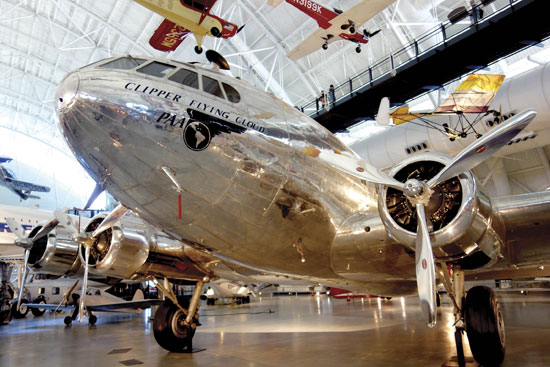
Udvar-Hazy Center
(Photo by Todd Franson)
Of course, the real treats are inside.
Greeting visitors -- just past security and the elaborate gift shop -- is arguably the Udvar-Hazy showpiece, the SR-71 Blackbird spy plane, featured as part of the Cold War Aviation exhibit. It's certainly got that testosterone edge that brings plenty to look at the amazing array of military planes. Like its downtown parent, however, this is by no means a military museum.
Sure, there's the Enola Gay, remembered this month for the plane's role in delivering the atomic bomb to Hiroshima, Japan, Aug. 6, 1945, and plenty of other warplanes. But that's just scratching the surface, because if there's an advantage to being in the fields of Chantilly, it's space. Lots of it. And Udvar-Hazy is filled to the brim.
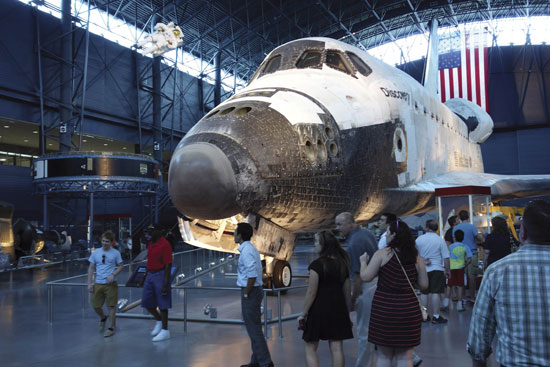
Udvar-Hazy Center: Space Shuttle Discovery
(Photo by Todd Franson)
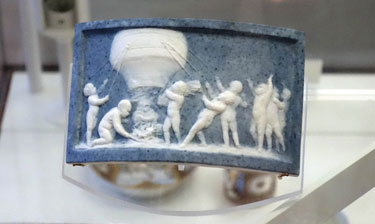
Balloon mania: Udvar-Hazy Center
(Photo by Todd Franson)
Stand within feet of the Space Shuttle Discovery. Study the belly from beneath an Air France Concorde, or climb to a higher perch and examine this unique plane from above. These are just a few of the heavy-hitters filling these enormous halls.
Do not, however, forget the interesting bits off to the side. Hugging the wall behind the Concorde, for example, just past the cup and saucer recovered from the Hindenburg, learn about ''Balloonmania,'' which reportedly had balloons taking over popular culture after a French balloon flight in 1783. Along with exhibits of balloon-inspired furniture, fabric and souvenirs, etc., Benjamin Franklin is quoted as saying in France, ''All the conversation here at present turns on the balloons, and the means of managing them so as to give men the advantage of flying.''
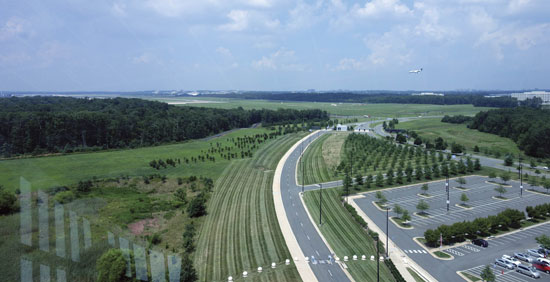
Udvar-Hazy Center
(Photo by Todd Franson)
The Udvar-Hazy Center is a glorious confirmation that men – and women – indeed have managed the means of flying. So much so that this temple dedicated to human achievements in air and space need not feel like hallowed ground. The center is also up for some fun, with flight simulators, an observation deck – for peering on Virginia flatlands and Dulles in the distance – and the Airbus Imax Theater, offering beer and wine in all classes, along with both documentaries and blockbusters.
The Udvar-Hazy Center is located at 14390 Air and Space Museum Parkway, Chantilly, Va. The museum is open year round, except Christmas Day. Regular hours are 10 a.m. to 5:30 p.m. Admission is free, but parking is $15, free after 4 p.m. For more information, call 703-572-4118 or visit airandsapce.si.edu.
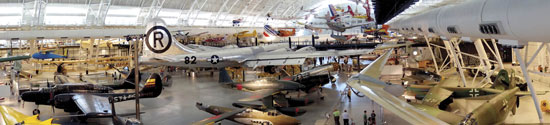
Udvar-Hazy Center
(Photo by Todd Franson)
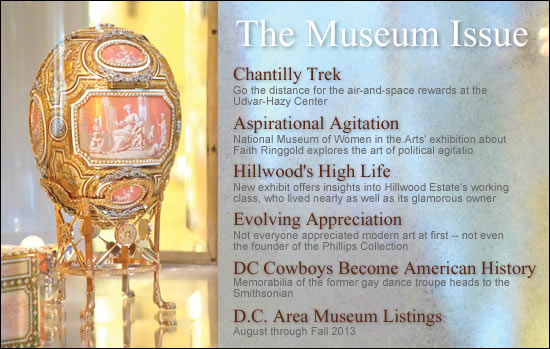 ...more
At the start of the 1970s, Faith Ringgold was commissioned to paint a mural for the female detention center at Rikers Island. One prisoner asked her ''to paint the road out of here.'' In response, Ringgold painted aspirational images of women: a female doctor, a female bus driver, a female president, even a white mother holding a mixed-race child.
''When she was painting this, most of those things were not reality -- women didn't hold those positions,'' says Kathryn Wat of the National Museum of Women in the Arts (NMWA), adding with a laugh: ''Now, we've ticked off almost all of them, except the woman president. But we'll see in a few years if we change that.''
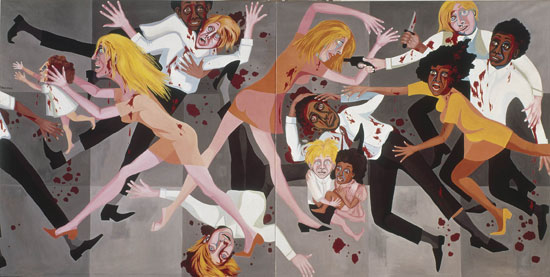
Faith Ringgold American People Series #20: Die
(Photo by courtesy ACA Galleries New York)
The painting, For The Women's House, was the first public commission by Ringgold, who is today best known for her work in the 1980s making painted story quilts. The painting is on display for the first time outside of Rikers at NMWA as part of the traveling exhibition American People, Black Light, a comprehensive survey of Ringgold's oil paintings.
''We just thought this was a perfect fit, and particularly this year,'' Wat says about the Ringgold retrospective at the women's art museum. Ringgold started making oil paintings in the early 1960s, and her political and figurative work was very much a response to race relations in the Civil Rights Era, which gained significant national attention with the March on Washington 50 years ago this month. In particular, Ringgold made her mark with particularly provocative paintings of patriotic symbols, from the American flag to a map of the United States, that prominently include violent imagery or information.
That drew her some attention -- but only some. ''She's not selling anything at this point. As she puts it, she couldn't give works away,'' says Wat, who during a guided tour of the exhibition singles out her favorite work as Ringgold's 1965 Self-Portrait, which was her largest work to date. ''She paints herself huge … and she looks so regal,'' Wat says, noting that the abstract design in the background harkens back to African design. ''Yet [Ringgold] has said that red sign in the back also looks a little bit like a stop sign, and that's how she felt at this point: sort of stymied.''
''She had this story that she wanted to tell,'' Wat continues, ''but nobody really wanted to hear it.''
That's a far too common story in the history of women artists, something that NMWA makes plain. In fact, Wilhelmina Cole Holladay was put on her path to starting the museum after she and her husband came up short trying to learn more about 17th century Flemish painter Clara Peeters, whom they first discovered while traveling abroad in the 1960s. The Holladays would eventually establish NMWA in 1987. Now, 26 years later, the museum is still shockingly the only museum in the world focused on women artists. But it's grown from the Holladays' core collection of about 500 objects to feature a permanent collection of 4,500 objects by 1,000 artists. This includes the only Frida Kahlo painting in all of D.C., as well as a sculpture -- yes, a sculpture -- by the 19th century French stage actress Sarah Bernhardt.
And it's all housed in a grand renovated building near Metro Center that was built in 1908 to be a Masonic temple, now owned outright by the museum.
''We take great pleasure,'' Wat says, ''in the fact that an organization and even a building that was once verboten to women is now devoted to them.''
American People, Black Light runs through Nov. 10 at The National Museum of Women in the Arts, located at 1250 New York Ave NW. Admission is $10. Call 202-783-5000 or visit nmwa.org.
...moreIn October, curator and historian Estella Chung will give a lecture titled ''D.C.'s Downton Abbey in a Mad Men Era.''
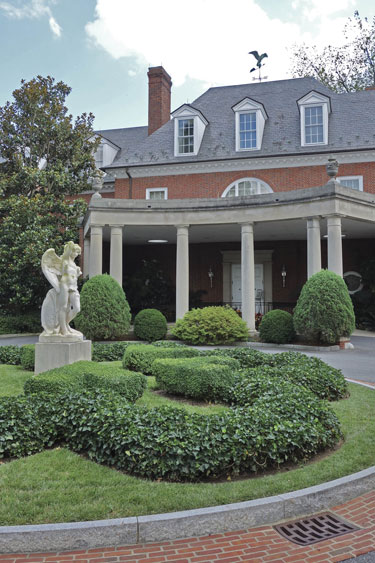
Hillwood Estate Museum and Gardens
(Photo by Todd Franson)
Of course the talk is about -- and occurs at -- Marjorie Merriweather Post's Hillwood Estate, nestled in the leafy hills of upper Northwest D.C. off Rock Creek Park.
''When you think of 'servant stories,' you often think of the turn of the century,'' explains Hillwood's Chung, ''but [Post] was able to carry on that tradition into the Mad Men era. In the Age of Aquarius, she was able to have a Gilded Age lifestyle.''
''But she was very much of the time,'' Chung is quick to add. This was no Upstairs, Downstairs type of life. ''Her staff lived above her, so it'd be 'upstairs, upstairs,''' she quips. In researching a book on the subject, Chung uncovered other ways in which mid-century life at Hillwood -- as well as Post's properties Camp Topridge in upstate New York and Mar-a-Lago in Florida -- differed from so many other mansions where servants would often slavishly cater to an estate owner's every whim. The outgoing, glamorous Post, who inherited her family's Postum Cereal Company, which is now part of Kraft Inc., ran her estate very much like a business -- specifically a hotel, welcoming people from all walks of life, all the time -- with an extensive organizational chart and an unbroken chain of command. Until her death in 1973, Post employed nearly 300 people at any given time over her three estates, and her ''staff'' -- never to be called servants -- were a diverse lot from places as far flung as Poland, Cuba and Norway, as well as the U.S.
Hillwood Estate Museum and Gardens
(Photo by Todd Franson)
Even granting that she was a perfectionist, former staffers told Chung that Post didn't overburden them. Rather, she treated them with grace and respect, paying high wages, offering medical benefits and being predictable in both hours and demands. ''On the one hand, she was incredibly difficult to work for because she had very high standards,'' Chung was told. ''But it was also very easy to please her because she made it abundantly clear what those standards were; there was no mystery to that.'' From all accounts, an impressive woman -- especially so, given that Post, though she did have several husbands in her day, was also an independent woman in an era when a female head of household was uncommon.
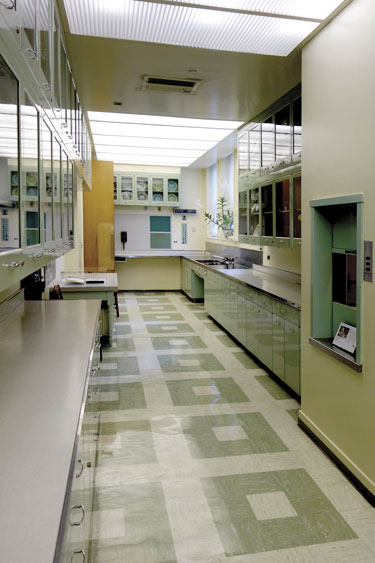
Chung's insights into the working class at Hillwood factor into a new exhibit at the estate based on her informative new book, Living Artfully: At Home with Marjorie Merriweather Post. ''If you've been to Hillwood before,'' explains Chung, ''you've had the opportunity to appreciate [Post's] decorative arts collection, but you were not told the stories of the life at the house. So that Downton Abbey aspect had not been revealed until this time.'' Also new are glimpses into her other two estates -- through memorabilia and videos -- as well as special access tours, offering views of one of Hillwood's four fallout shelters, the movie-pavilion balcony with gorgeous film-projection booth and Post's personal massage room.
Hillwood Estate Museum and Gardens
(Photo by Todd Franson)
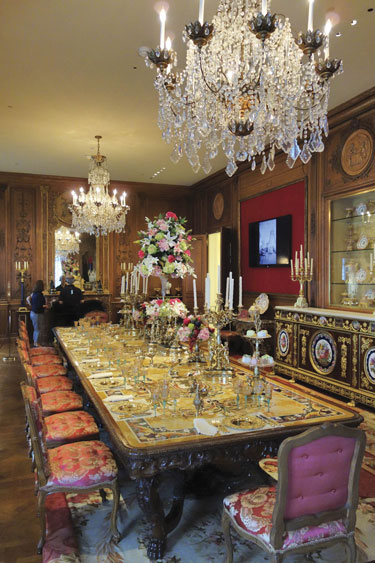
Saturday, Sept. 28, Hillwood hosts its annual Gay Day event, but really any day can be a good gay day to take in the riches of Hillwood, from beautiful and finely detailed Fabergé eggs as part of Post's extensive French and Russian decorative arts collections, to her elaborately and meticulously set dining table, to the gorgeously appointed gardens on the property. In many ways a visit to Hillwood serves as both a nice retreat from the hubbub of daily life as well as an inspiration to make that daily life better.
''Her life was so full of art, and she lived it artfully,'' Chung says about Post, noting that Post put ''incredible skill and care into the day-to-day way of living.''
Living Artfully runs through Jan. 12, 2014, at Hillwood Estate and Museum, located at 4155 Linnean Ave. NW. Suggested donation is $12, plus $12 for special-access tours. Call 202-686-5807 or visit hillwoodmuseum.org.
...moreFollowing the official release of her new music video, 'Applause,' on Monday, we list a dozen examples of what makes Lady Gaga an LGBT ally worth cheering.
A new study from Empire State Pride Agenda reveals LGB New Yorkers are more likely to suffer from mental health problems and be victims of sexual assault than their heterosexual counterparts.
- Sponsors -


No comments:
Post a Comment